
Bridging Tradition and Technology: Robotics in Infrastructure
The field of robotics is rapidly reshaping how infrastructure is inspected, maintained, and improved. The Gedeon Robotics Department is a team effort—driven by multidisciplinary expertise and a shared commitment to solving real-world challenges.
In this Q&A, our department answers some of the most pressing questions about robotics in engineering, sharing lessons learned, recent breakthroughs, and our vision for the future.
Q&A with the Gedeon Robotics Department
Q: How did your department identify which legacy processes could be replaced or reimagined with robotics?
A: We started by engaging with colleagues across departments to understand their workflows and pain points. Patterns emerged in areas where manual inspection or repetitive documentation consumed significant time without adding equivalent value. Our approach was to rethink the purpose and flow of each process, mapping workflows end-to-end, and questioning long-held assumptions. For us, innovation starts with reimagining how work gets done and letting that drive how we invest in technology.
Q: What were the biggest limitations of traditional inspection and data collection methods before drones and robotics?
A: Traditional methods often require human inspectors to access challenging and sometimes dangerous locations—such as towers or bridges with heavy traffic. Often, fatigue from repetitive tasks and long hours leads to human error in reporting and recording data. These methods also limit the frequency and scope of data collection, typically resulting in subjective snapshots rather than continuous, objective streams. Robotics has the potential to transform this process, enabling proactive, data-driven decision making, and continuous monitoring.
Q: What kinds of data were difficult or impossible to collect before robotics, and how has that changed?
A: Before robotics, collecting high-resolution spatial and temporal data—such as geolocated images and centimeter-precision Lidar—was logistically challenging. Now, with automated flight paths and synchronized sensors, we capture complete environmental pictures quickly and efficiently. This shift has made data collection a strategic asset, allowing us to focus on leveraging insights rather than worrying about data sufficiency.
Q: Can you share an example where robotics enabled full coverage or precision that traditional methods couldn’t achieve?
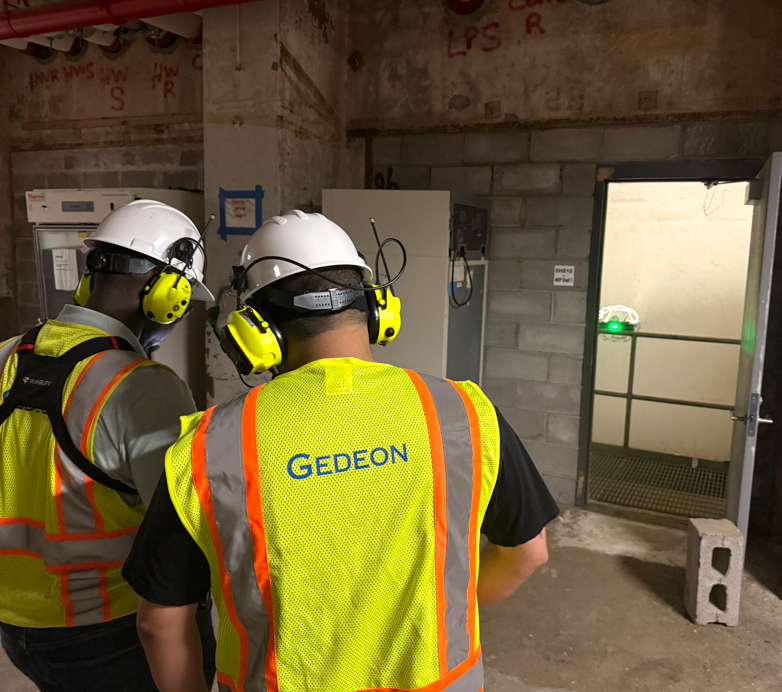
A: Robotics has enabled us to collect data inside refinery chambers, a task that previously required extensive scaffolding, person-hours and exposed workers to extremely hazardous environments. Our use of remotely operated platforms allowed us to efficiently navigate tight spaces, maintain consistent imaging angles, and generate 3D models for collecting measurements and informing structural analysis. This capability allowed on-site engineers to visualize previously inaccessible areas and make informed decisions without compromising safety or continuity.
Q: What makes the Gedeon Robotics Department uniquely positioned to innovate in this space?
A: Our department thrives on a multidisciplinary mindset—combining traditional engineering expertise, robotic operations experience, proven data science, planful software development, and creative problem-solving. We see robotics not as a standalone tool, but as an enabler of smarter infrastructure management, design, and construction. At Gedeon GRC, experimentation is encouraged, and every innovation is tied to real-world challenges faced by our engineers, our clients and our partners.
Q: How does the team balance experimentation with reliability when developing new tools or workflows?
A: We maintain a dual-track approach: one focused on controlled prototyping and another on rigorous testing before deployment. Collaboration with end-users ensures new tools meet real needs while maintaining the trust that comes from proven performance. Reliability is non-negotiable, especially in infrastructure and engineering.
Q: What’s the department’s vision for robotics in infrastructure and engineering over the next five years?
A: It’s hard to say for sure, though recent trends show a move towards more automated measurement and documentation tools, allowing robotics solutions to shift from primarily focused on data collection to more wholistically supporting intelligent interpretation. Integration with digital twins, AI-assisted decision-making, and autonomous maintenance workflows will blur the boundary between fieldwork and analysis, creating a more connected and sustainable infrastructure ecosystem.
Q: What advice would you give to other engineers or firms trying to break out of legacy workflows and embrace innovation?
A: Innovation starts with curiosity and humility—questioning whether “the way we’ve always done it” is still best. Start small, measure impact, and build momentum. Foster a culture where experimentation is safe and learning is shared. Transformation happens through a cohesive vision of improvement, not disruption for its own sake.


